Record Defense Spending Drives Market Growth
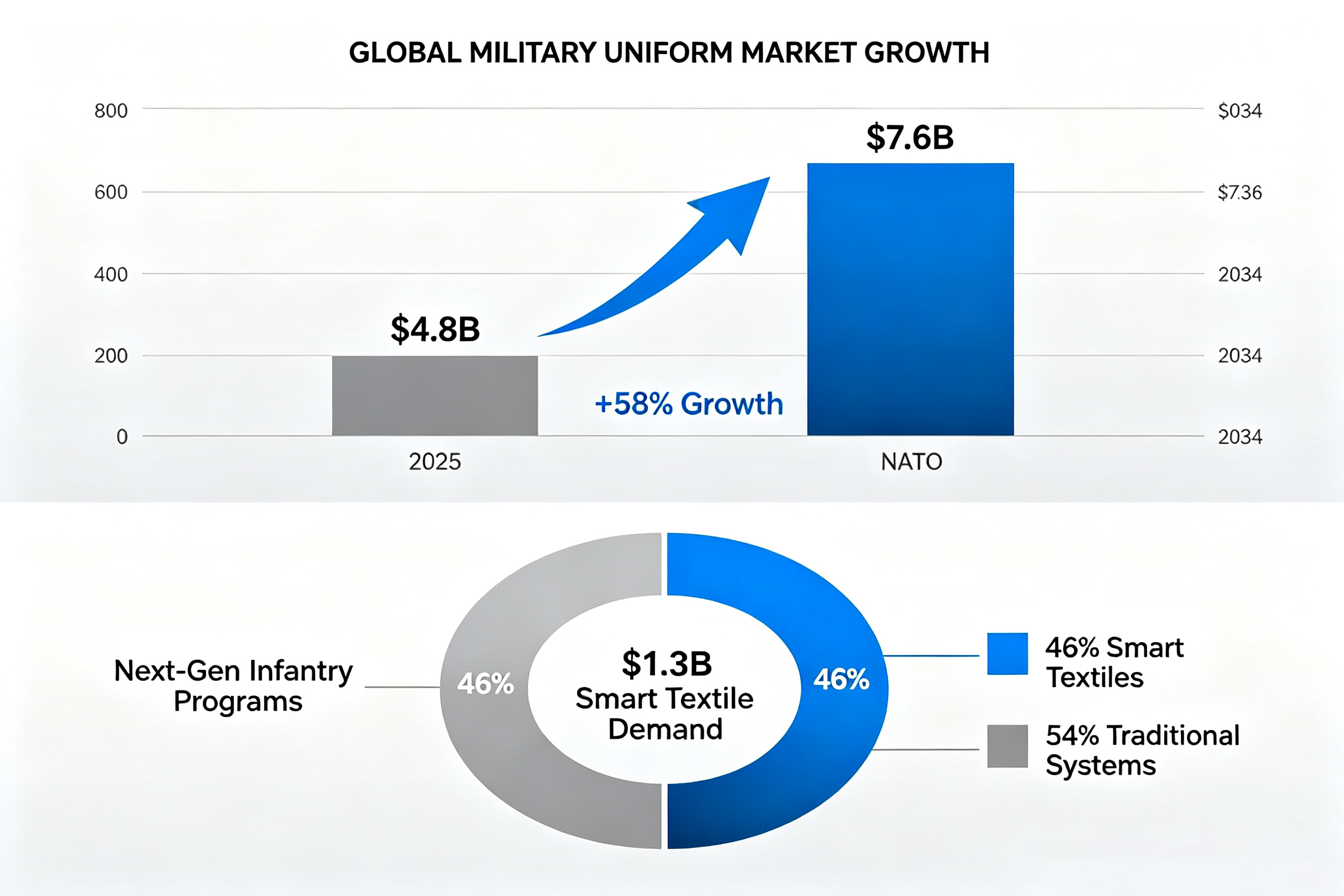
European defense budgets have reached unprecedented levels. In 2025, total defense spending by EU member states is estimated at €392 billion, exceeding 2% of GDP for the first time on a group average. NATO leaders pledged at their June 2025 summit to increase defense spending to 5% of GDP by 2035. The €150 billion SAFE (Security Operations in Europe) program launched by the European Parliament further accelerates this trend, with at least 40% of defense procurement expected to be collective by 2027. The global military uniform market is estimated at $4.8 billion in 2025 and is projected to reach $7.6 billion by 2034.
.png)
Lightweight Materials: Protection Without Sacrificing Mobility
Traditional ballistic protection places a heavy burden on soldiers. New military uniform systems combine ultra-high molecular weight polyethylene fibers, graphene composites, and aerogel insulation layers, providing the same level of protection while significantly reducing weight. A single modern military uniform can simultaneously counter ballistic fragmentation, chemical/biological/radioactive/nuclear (CBRN) agent penetration, and thermal exposure threats—eliminating the need for multiple layers of protective gear. This integration reduces the weight of infantry equipment while enhancing flexibility in cross-terrain operations.
Flame Retardancy and Multi-Environment Camouflage
Flame retardancy is now a mandatory requirement for NATO member states' procurement. The Irish Defence Force's €5.2 million tender for a flame-retardant clothing system reflects the unification of safety standards across the alliance. Multi-environment camouflage has replaced dedicated patterns for specific theaters of war. Near-infrared management technology, which reduces the probability of detection by night vision equipment, has become a near-universal requirement. Modern projects demand a single camouflage system suitable for Arctic, desert, woodland, and urban environments.
Smart Textiles: Connected Soldiers
By 2026, approximately 46% of NATO's Next Generation Infantry Modernization projects will integrate smart textile-based sensing layers into combat uniforms, with related deployment requirements approaching $1.3 billion. Embedded biosensors can monitor core body temperature, heart rate, and CBRN exposure levels in real time. These integrated systems reduce wearable equipment weight by 18% in high-mobility operations while improving sensor data continuity by 26%. Command-level situational awareness and faster battlefield medical response are direct operational benefits.
Standardization Enables Interoperability
NATO Support and Procurement Agency manages 32 multinational support partnerships covering more than 90 weapon systems. This framework encourages member states to harmonize uniform specifications, creating economies of scale in procurement. The European defense industry's strategic goal is to achieve 35% intra-EU defense trade, driving manufacturers to meet both national standards and NATO requirements. Suppliers with multi-regional production capabilities have a structural advantage.
Sustainability of the Defense Supply Chain
Environmental standards are being incorporated into long-term defense contracts. Rapid on-site decontamination after CBRN exposure is a priority, driving the development of surface treatment technologies that can withstand repeated washing without performance degradation. European defense agencies increasingly demand responsible material sourcing and end-of-life recyclability. This creates new dimensions of competition beyond pure technical performance.
Market Outlook
Combat uniforms account for 42.3% of total military uniform market revenue and are projected to grow at a CAGR of 5.6% through 2034. Growth drivers include the replacement of aging NATO forces' inventory, procurement in emerging markets, and continued investment in next-generation protection technologies. For manufacturers, historic spending levels, breakthroughs in materials science, and the convergence of NATO standardization have created a rare window of opportunity.
The shift from uniforms to integrated protection systems reflects a strategic reality: in modern warfare, soldiers' attire directly impacts mission success or failure.